

The world is not short on bad news. Gas prices remain stubbornly elevated. Congress has lurched from one standoff to the next, the SAVE America Act is still grinding through the Senate, and a partial Department of Homeland Security shutdown is dragging into its fourth month. Overseas wars grind on. Americans looking for something to feel good about have had to look hard. On April 1, we were given reason to look up.
At 6:35 p.m. EDT, NASA’s Space Launch System rocket lit up the Florida sky from Kennedy Space Center’s Launch Pad 39B and hurled four astronauts — Commander Reid Wiseman, pilot Victor Glover, and mission specialists Christina Koch and Canadian Space Agency astronaut Jeremy Hansen — on a journey no one had made in more than half a century. By April 6, they had swung around the moon and traveled 4,700 miles beyond it, farther from Earth than any humans in history. On April 10, they splashed down off the California coast, having completed the most complex and far-reaching crewed mission since Apollo 17 in December 1972.
The reaction was something America rarely experiences anymore: unanimous joy. Across party lines, across cable news, across social media feeds more accustomed to culture-war trench warfare, Americans of every stripe looked up and simply marveled. The astronauts had not solved anything on the ground. The debt is still mounting. But for 10 days, something magnificent happened in the sky, and we remembered, together, that we are still capable of magnificent things.
The long road back
The Artemis II mission did not emerge from thin air. It was the product of a deliberate political choice made nearly a decade ago, when a first-term President Donald Trump decided that America’s human spaceflight program had grown too small in its ambitions. The Obama years had seen NASA steered toward an asteroid mission of uncertain purpose. Trump changed that, pointing the agency back at the moon and, beyond it, Mars.
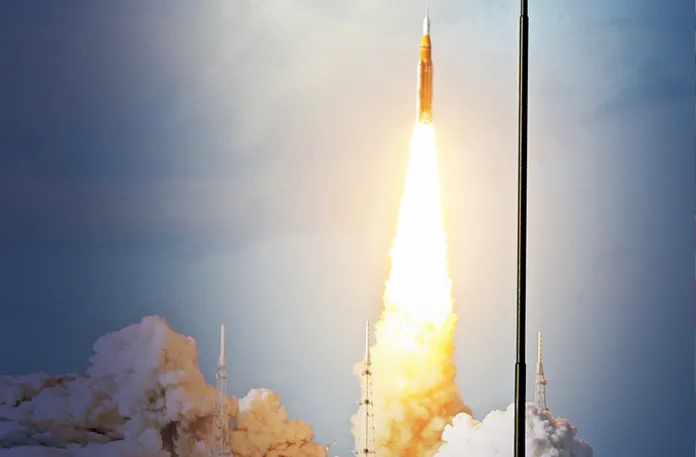
The program survived a change of administration, a global pandemic, years of budget battles, and no shortage of technical setbacks. But the essential direction held, and when Trump returned to the White House, he accelerated hard. He signed an executive order in December 2025 calling for Americans to return to the moon by 2028 and establish the initial elements of a permanent lunar outpost by 2030, including nuclear reactors on the moon and in orbit. With that mandate in place, NASA unveiled its “Ignition” plan in late March, just days before launch. NASA Administrator Jared Isaacman declared the agency “committed to achieving the near-impossible once again — to return to the Moon before the end of President Trump’s term, build a Moon base, establish an enduring presence.” The clock, Isaacman said, was measured in months, not years.
A man of faith in the void
Of the four astronauts who made the journey, none captured the country’s imagination quite like Victor Glover. A Navy test pilot and decorated military officer, Glover became the first black astronaut to travel beyond Earth’s orbit. It was a milestone that, in the current political moment, he chose to frame in notably pointed terms.
At a March press event ahead of launch, Glover said: “It’s about human history. It’s the story of humanity — not black history, not women’s history — but that it becomes human history.” The clip spread widely, helping make the moon mission even more popular. Here was an astronaut, an individual at the frontier of human endeavor, who refused to let the grandeur of the mission be reduced to a demographic checkbox. If only we could carry this spirit over into the rest of our enterprises. (I pray for the day when colleges and jobs stop asking me to disclose my race and ethnicity on applications. I’m sorry, but how is the question of whether I’m black, white, Latino, or Asian relevant to whether or not I can teach religious studies and comparative literature?! Okay, end of rant and back to more inspiring stuff!) Glover added that “I also hope we are pushing the other direction that one day we don’t have to talk about these firsts, that one day, this is just — listen to this — that this is the human history.” Amen!
Then came Easter Sunday. Drifting in the vast silence between Earth and moon, Glover appeared in a live CBS News interview and said: “I can really see Earth as one thing. When I read the Bible, and I look at all of the amazing things that were done for us, who were created, you have this amazing place, this spaceship.”
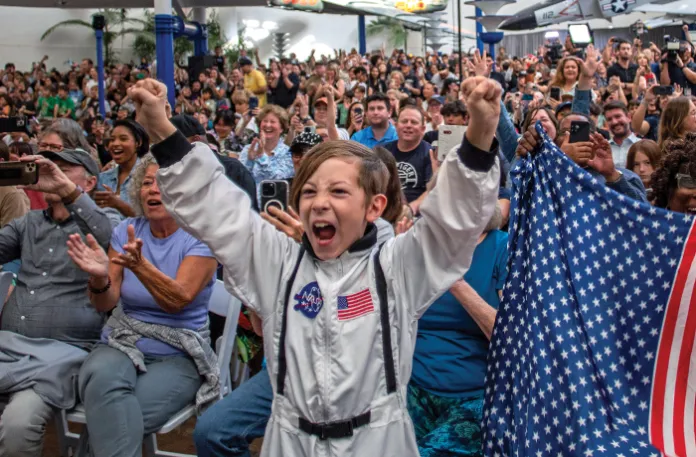
After splashdown, at the crew’s first public appearance in Houston, Glover told the crowd: “I wanted to thank God in public … the gratitude of seeing what we saw, doing what we did and being with who I was with, it’s too big to just be in one body.”
Commander Wiseman offered his own reflections: “We are bonded forever, and no one down here is ever going to know what the four of us just went through. And it was the most special thing that will ever happen in my life.”
The race that dare not speak its name
The wonder of Artemis II carries a harder edge when you widen the frame. China has confirmed it is “on track” to land astronauts on the moon by 2030. A robotic prototype of its Lanyue lunar lander is scheduled for trials in 2027 and 2028, with a full uncrewed mission planned for 2028 or 2029. The schedule is credible. China has demonstrated a steady, disciplined cadence, from its Tiangong space station to the first-ever return of samples from the moon’s far side in 2024.
The stakes are not merely symbolic. Former NASA Associate Administrator Mike Gold has put it plainly: “The countries that get there first will write the rules of the road for what we can do on the Moon.” The lunar south pole — where both nations intend to establish a long-term presence — sits atop deposits of water ice convertible into drinking water, oxygen, and rocket fuel. Whoever controls that terrain holds a decisive strategic advantage. Trump administration officials said as much at this week’s Space Symposium in Colorado Springs, framing Artemis II’s success as a critical step in what they called a great-power competition measured in months.
‘Artemis II was a reawakening’
To understand what Artemis II actually accomplished and what must follow, I spoke with Brian Keating, an astrophysicist at the University of California, San Diego, a member of the International Air and Space Hall of Fame, and one of the country’s most prominent scientific voices on space policy.
Keating did not speak in the hedged tones of a bureaucrat counting line items. He spoke like a man who grew up wanting to go to space and has spent his career trying to understand why it matters.
“Artemis II was a reawakening,” he said. “I grew up in the Space Shuttle era, when launches weren’t rare spectacles but part of the cultural atmosphere — like thunderstorms you could predict and still be awed by. I watched the Challenger tragedy live in 1986 in ninth grade, and that moment never leaves you. It seared into me a dual truth: Spaceflight is both transcendent and brutally unforgiving.”
For Keating, the technical significance of Artemis II is hard to overstate.
“This is the first time since Apollo 17 that humans left Earth orbit,” he said. “This isn’t symbolic — it’s a full systems validation of the Orion spacecraft and Space Launch System stack. It proved we can navigate, sustain life, and return safely from deep space.”
But his excitement ran deeper than mission parameters. The moon, he explained, is not merely a destination. It is a scientific platform unlike anything humanity currently possesses.
“The far side of the moon is the most radio-quiet environment accessible to humanity,” he said, “a pristine window into the cosmic dark ages before the first stars ignited. Imagine low-frequency radio arrays probing the hydrogen line at redshifts we’ve never touched. Imagine particle accelerators that don’t need vacuum chambers because the vacuum is already there. Imagine interferometric baselines spanning kilometers, or even the lunar diameter itself.”
Keating has made two trips to the South Pole, operating precision instruments in one of the most hostile and isolated environments on the planet. “Standing at the bottom of the Earth,” he said, “you begin to understand astronauts differently.”
He has even debated moon landing deniers publicly to make the case for Artemis. He was unequivocal about the program’s quality. “I’ve been one of NASA’s biggest cheerleaders my entire career,” he said. “I worked for NASA at Langley on aircraft safety, and I believe in this program. I think Artemis is thoughtfully designed, technically sound, and scientifically rich.”
But Keating did not allow his enthusiasm to curdle into boosterism. He pressed the harder question that the celebration cannot ultimately obscure.
“The budget simply doesn’t match the ambition,” he said. “When you run even crude back-of-the-envelope calculations — cost per launch, cadence, infrastructure buildout — it becomes hard to see a coherent roadmap beyond Artemis IV. And that’s dangerous. We’ve seen this before. After the third Apollo landing, public attention faded. After the early Shuttle flights, normalization set in. Without a sustained, escalating vision, exploration decays into routine — and routine is where programs go to die.”
His prescription was sweeping: “We need to think bigger and longer-term,” which would entail fusion-powered infrastructure on the moon, mass drivers using lunar regolith as both a resource and shielding, asteroid-mining pipelines feeding a cislunar economy, and permanent astronomical observatories. What we need, he emphasized, are “actual, testable, buildable physics.”
“We were promised a future in 1961 that we still haven’t fully claimed,” Keating said. “Artemis II is the handoff from Apollo’s past to whatever future we’re bold enough to build. The question isn’t whether we can do it. It’s whether we’ll have the courage to risk the capital, time, and even human lives to do so.”
The road from here
What comes next, on NASA’s current timeline, is a sequence of increasingly audacious steps. Starting in 2027, a near-monthly cadence of robotic missions to the lunar south pole will test power, mobility, and navigation systems. Artemis IV and V, currently scheduled for 2028, would be the first American crewed landings on the moon since 1972. And in 2028, NASA plans to send a nuclear-electric spacecraft, SR-1 Freedom, on a propulsion test mission toward Mars.
Isaacman has been explicit about the logic: the moon is “the perfect proving ground to master the skills you’ll need for what comes next,” including the in-situ resource manufacturing essential for any realistic Mars mission. Trump, Isaacman says, has repeatedly told him that NASA should “figure out what we need to do to go to Mars.”
Whether the budget can sustain all of it is the central question. The proposed fiscal 2027 NASA budget boosts Artemis while cutting the science directorate by nearly half, a trade-off that has alarmed researchers who argue that gutting the underlying science infrastructure undermines the very exploration it is meant to support. Congress rejected a similar proposal last year. Keating’s warning about programs dying when vision outpaces commitment hangs over the moment.
Something worth feeling
On April 6, somewhere 4,700 miles past the moon, Victor Glover looked out a window at the universe and felt something the budget debates and cable-news grievances could not touch.
“Earth was just this lifeboat, hanging undisturbingly in the universe,” Christina Koch told the crowd at Ellington Field. “Planet Earth, you are a crew.”
ARTEMIS II REMINDS AMERICANS TO STRIVE FOR THE STARS
The moon landings of the late 1960s gave a nation torn by Vietnam and assassinations a reason to feel proud about our country once again. Artemis II arrives at a moment when we’re experiencing different kinds of divisions, but the hunger for transcendence remains the same.
The work of ensuring that Artemis III, the moon base, and eventually Mars fulfill that promise belongs to the politicians, engineers, budget writers, and voters who decide what kind of country we want to be. The stars are there. The only question, as it has always been, is whether we will reach for them.
Daniel Ross Goodman is a Washington Examiner contributing writer and the Allen and Joan Bildner Visiting Scholar at Rutgers University. Find him on X @DanRossGoodman.