

State attorneys general have filed at least 145 lawsuits against the Trump administration since Donald Trump returned to the White House in January 2025.
That is already more than the 138 filed during Trump’s entire first term. State AGs filed 78 multistate suits against the Obama administration and 76 against George W. Bush, according to a Gibson Dunn analysis of the growing role of state attorneys general.
Politically, it is easy to look at those numbers and see partisan “lawfare.” Democratic attorneys general have organized themselves into a legal opposition to Trump. Republican attorneys general did much the same thing under Presidents Barack Obama and Joe Biden. Both sides argue that the lawsuits are political, depending on which side files.
Two problems highlight the issue. First, presidents have become much more comfortable allowing their legal teams to devise inventive arguments that the executive branch has clearance to do what it wants, and Congress helped create the conditions that made hundreds of lawsuits possible.
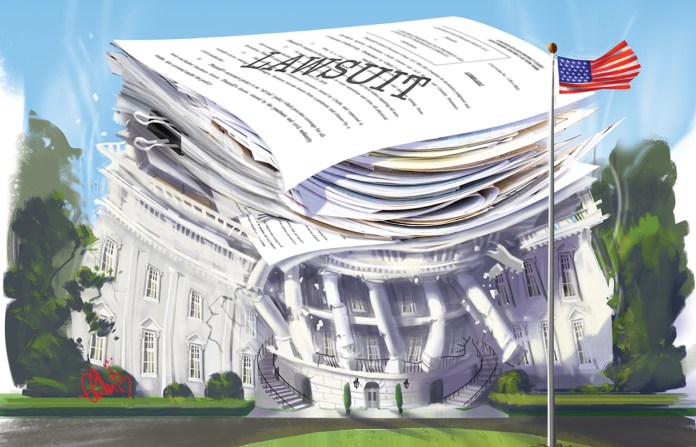
For decades, Congress passed broad, vague statutes, leaving the executive branch with ample room to decide how those laws are applied. Presidents take the authority Congress gave them or the ambiguity in the law to push it as far as they think they can. The only time members of Congress become concerned about executive overreach is when the president belongs to the other party. The state attorneys general, meanwhile, head to court.
The pattern continues from one administration to the next. We’ve reached a point now where presidential candidates no longer say they’ll “work with” or “ask” Congress for legislation, but “demand” it, and promise to act on their own if Congress doesn’t bow to their will. It’s a complete distortion of the separation of powers.
James Madison warned in Federalist No. 47 that the accumulation of legislative, executive, and judicial power in the same hands could “justly be pronounced the very definition of tyranny.”
Justice Robert Jackson warned about this in a case that’s nearly 75 years old. His concurrence in Youngstown Sheet & Tube Co. v. Sawyer, the case rejecting President Harry Truman’s seizure of steel mills during the Korean War, remains one of the starkest warnings about the accumulation of presidential power.
In the 1952 case, Jackson described a “zone of twilight” where presidential and congressional authority overlap. He warned that “congressional inertia, indifference or quiescence” could “enable, if not invite” presidential action.
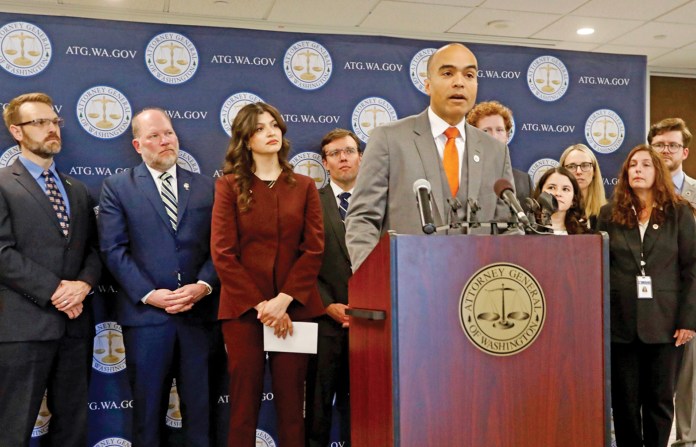
challenging President Donald Trump’s executive order attempting to overhaul elections in the U.S., April 4, 2025. (Manuel Valdes/AP)
In the modern political era, Congressional inaction and the expansion of presidential power have become features, not bugs.
It started in part with the Bush administration following the 9/11 attacks, when GWB exercised broad executive authority related primarily to foreign policy. The architect was Vice President Dick Cheney, who said in 2005, “I believe in a strong, robust executive authority and I think that the world we live in demands it.”
On the domestic front, Obama provided one of the clearest examples on immigration. Ironically, he initially argued for executive restraint. At a Univision town hall in March 2011, Obama was asked why he could not simply stop deportations of young illegal immigrants who would have benefited from the DREAM Act.
“With respect to the notion that I can just suspend deportations through executive order, that’s just not the case,” Obama said in his answer. He explained that Congress had passed immigration laws and that the executive branch was obligated to enforce them.
“For me to simply, through executive order, ignore those congressional mandates would not conform with my appropriate role as president,” Obama said.
Fifteen months later, his administration created Deferred Action for Childhood Arrivals. DACA allowed hundreds of thousands of illegal immigrants brought to the United States as children to receive renewable protection from deportation and work authorization.
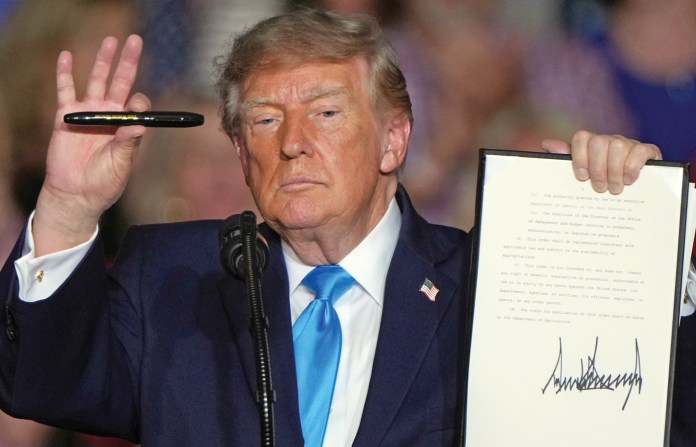
Congress had not changed the law. Obama had changed his view of what the executive branch could do under it.
That approach soon became part of his broader response to congressional opposition. In his 2013 State of the Union address, Obama said that if Congress would not act on climate policy, he would. By 2014, he had boiled the idea down to a slogan: “I’ve got a pen, and I’ve got a phone.”
Republican-led states took the Obama administration to court. Texas led a multistate challenge to his 2014 immigration actions and, in 2018, led seven states in a direct challenge to DACA itself. Texas Attorney General Ken Paxton said DACA gave the executive branch “sweeping authority to ignore the laws enacted by Congress” and change immigration law based on a president’s policy preferences. Texas was joined by Alabama, Arkansas, Louisiana, Nebraska, South Carolina and West Virginia.
That fight was about immigration, but it set a precedent. And the bigger issue is not what’s happening in the moment, but what comes next.
The next president was Donald Trump.
Trump has never shown much interest in arguments for a restrained executive. During his first term, while discussing the Mueller investigation at a Turning Point USA event, he said, “I have an Article II, where I have the right to do whatever I want as president.”
Of course, Article II says no such thing. But the comment was revealing because Trump dispensed with the careful legal language presidents usually use when pushing the limits of executive authority.
Republicans had spent years attacking Obama’s “pen and phone” approach and warning about an imperial presidency. Once Trump took office, Congress did not make a serious effort to claw back that authority.
Biden, contrary to his promises, did not slow things down.
In addition to his many executive actions taken during COVID-19, his most audacious step was student loan cancellation, which became one of the clearest examples. What’s more striking is that then-House Speaker Nancy Pelosi had already said Biden lacked the authority to do it.
“People think that the president of the United States has the power for debt forgiveness. He does not,” Pelosi said in July 2021, according to the Washington Post. “He can postpone. He can delay. But he does not have that power. That has to be an act of Congress.”
Thirteen months later, Biden announced a plan to cancel up to $10,000 in federal student debt for qualifying borrowers and $20,000 for Pell Grant recipients.
The administration relied on the HEROES Act, a 2003 law passed after the Sept. 11 attacks that allowed the education secretary to waive or modify student loan requirements during a war or national emergency.
Pelosi did a 180, praising the move and saying it was part of Biden’s “commitment to justice and equity.”
Six Republican-led states sued. The case reached the Supreme Court, which struck the program down 6-3 in Biden v. Nebraska. The Court said the program would have affected roughly 43 million borrowers and canceled about $430 billion in federal student loan debt, essentially holding that the administration would be appropriating taxpayer funds, which it lacks authority to do.
Members of Congress become much more protective of their authority when the president belongs to the other party. Democrats spent the Trump years warning about authoritarianism and executive overreach. Republicans spent the Obama years saying much the same thing. Pelosi said Biden lacked the power to cancel student debt without Congress, then applauded him when he tried.
Trump II has brought the cycle back around, and the president, knowing this is his lame-duck term, hasn’t hesitated to push executive authority to the limit.
His administration has asserted executive authority over immigration, federal spending, regulation, personnel policy, trade, and other issues. Democratic attorneys general have responded with lawsuit after lawsuit, often in groups, trying to block policies before they take effect or force courts to decide how much authority Congress actually gave the president.
That leaves federal judges deciding questions that Congress could often have answered itself.
It has become an all-too-familiar pattern: members of opposing parties attack the judicial branch when a decision doesn’t go their way and complain that judges are “writing laws” and “making policy.” The press then writes stories about the “legitimacy” of the courts and its supposed “politicization.”
Congress has plenty of ways to stop this. It can write narrower laws, put clearer limits on emergency powers, update old statutes, and reclaim authority that has drifted toward agencies and the White House.
But doing so requires voting, and casting a vote puts them on record.
That is the part lawmakers tend to avoid. A vote forces members to put their names next to a policy and defend it to voters. Delegating authority to the executive branch is easier. So is cheering when a president from their own party stretches that authority. And so is complaining about executive overreach when the other party takes power.
Granted, some of the 145 lawsuits against Trump are partisan fights, with suits filed before friendly judges who tend to act more as a stopgap than anything else. But others have merit. This is not “governing,” and it hands issues to courts it wouldn’t have to involve itself in if Congress did its job and presidents showed more restraint.
Congress can fix all this on its own. A largely perpetuated myth is that all branches of government are “coequal.” Congress has supreme power. The presidency was created by the Constitution, and for the most part, the president is to do what Congress says, not the other way around.
VANCE AND THE GOP’S HAMILTONIAN TURN
Political historian Jay Cost put it this way: “If I get to tell you what to do, but you do not get to tell me what to do, who is actually in charge?”
Until that changes, expect a whole lot more lawsuits filed by state attorneys general.
Jay Caruso (@JayCaruso) is a writer living in Florida.