

Please don’t interpret this as a cry for help, but: I like to eat alone sometimes. Not always, of course. No one enjoys a convivial dinner with friends and companions as much as I do, but every so often I like to sit at the bar of a local restaurant with a book or the newspaper, a steak, and a glass of red wine. It’s one of the great uncomplicated pleasures of adult life, and like every uncomplicated pleasure, someone is always trying to complicate it.
A few nights ago, it was the bartender. He set a second glass next to mine and poured a splash of something into it and slid it toward me. I looked up from the Sunday paper I was reading — and, crucially, enjoying.
“Would you like to try this?” he asked. “I often find that a Cabernet and a steak are great” — and here he pointed to my meal and my wine glass, which was filled with the wine I had ordered and, significantly, was enjoying, and shrugged — “I mean, it’s the safe choice, but this one here has a little more acidity to stand up to the meatiness of the steak.”
I mean, I think that’s what he said. The minute my brain detects that someone is about to talk about wine, it shuts down immediately and I begin, as they say in the psychiatric field, to dissociate. My face becomes a mask of polite interest, my eyes focus on the middle distance, and I wait until my ears register silence to snap out of it. I also do this whenever the conversation turns to climate, Trump, indigenous foodways, or the Federal Reserve, among other topics, and I find myself adding new categories on a weekly basis.
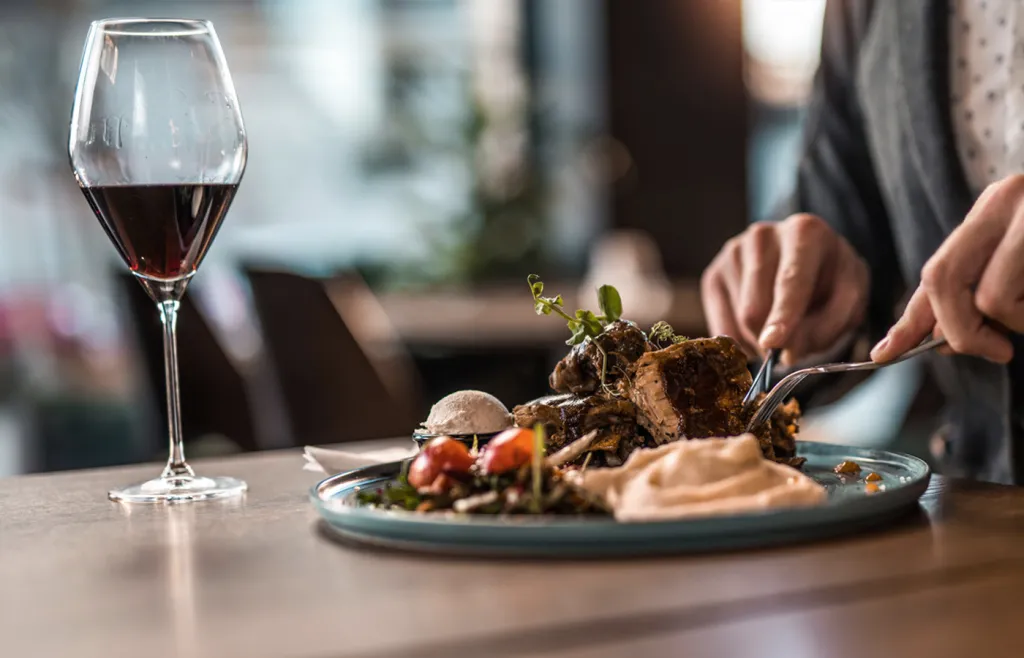
But what could I do? I tasted the wine in the glass. He was trying to be nice, and it seemed unnecessarily grouchy to refuse, even though what he had essentially done was walk over and inform me that my dinner was a bore. And at the risk of causing the reader to dissociate, here’s what I’ll say about the wine: It was fine. It was a perfectly good wine. It was, I suppose, more acidic. Was it better? I have no idea. But I wasn’t looking for better. I was looking to finish reading the Sunday paper with a steak and the wine I ordered.
C.S. Lewis had a name for this, though he put it in the mouth of a devil. In The Screwtape Letters, the senior demon Screwtape is delighted that modern people no longer worry much about the gluttony of overeating, because it frees him to work on a subtler version he calls the gluttony of delicacy. His example is a woman who never wants much — just a cup of weak tea and “the teeniest weeniest bit of really crisp toast.” But she will send back the tea, and the toast, and exhaust her hostess, the servers, and everyone within earshot until she gets it. She doesn’t overeat. She over-fusses. And that’s a kind of gluttony, too.
The bartender, I should say, is no devil. He’s a nice young guy doing his job. But his job, increasingly, is the one Screwtape assigned to his nephew: find someone perfectly content with what he’s got and suggest, very politely, that he could do better.
WHEN ANOTHER’S FEAR IS OUR ENTERTAINMENT
Look, nobody is trying to get me to eat more these days. Eating bigger portions is for bodybuilders and cruise ships. And in any case, we’re a nation on semaglutides and dulaglutides — eating more won’t scratch an itch we no longer feel. But a culture that wants less isn’t abstemious or easygoing. It’s more demanding but in lesser portions. Screwtape would recognize it immediately. Tell him his wine choice was safe, he’d whisper to his bartender accomplice. He’s only going to have one glass, so he should think it was the wrong one.
Next Sunday, I’m going back to that bar with the paper and a steak, and I’m ordering my original wine even though, if I’m honest, the wine he suggested was perfectly tasty and also cheaper. I will do that because I am stubborn and competitive, which gives Screwtape even more to work with.
Rob Long is a television writer and producer, including as a screenwriter and executive producer on Cheers, and the co-founder of Ricochet.com.